Scenarios & Selection
Underground and enclosed environments span a wide range of operational contexts, each presenting a distinct combination of environmental stressors, security objectives, regulatory requirements, and maintenance constraints. This chapter presents eight representative application scenarios, each with a real-world site image, a detailed description of the environment and security challenges, and a set of key technical indicators that define the minimum acceptable performance for that scenario. The selection guidance at the end of each scenario maps these indicators to the appropriate solution package from Chapter 2.
3.1 Underground Parking Garage

Underground parking garages present a challenging combination of mixed illuminance (fluorescent overhead lighting with deep shadows at pillar bases and ramp transitions), wet and reflective floors that cause IR bloom, vehicle headlight glare at entry/exit ramps, and high pedestrian/vehicle traffic density. Security objectives include license plate recognition at entry/exit, personal safety monitoring throughout the parking area, perimeter access control at elevator lobbies and stairwells, and evidence-grade recording for incident investigation. The environment typically has moderate humidity (RH 60–80%) with seasonal variation, and EMI levels are low to moderate. Maintenance access is constrained but feasible during off-peak hours.
3.2 Metro Station Concourse & Ticketing Area

Metro station concourses and ticketing areas combine extreme WDR challenges (bright daylight from surface exits vs. artificial underground lighting), high pedestrian density during peak hours, and stringent public safety requirements. Turnstile and fare gate areas require face-level identification cameras with rapid frame rate for crowd flow analysis. Staff-only access doors require two-factor access control with anti-passback. Emergency exits must be monitored with fire-linkage capability. EMI from traction power systems may be present in adjacent areas. Public-facing areas require privacy-compliant camera placement and signage.
3.3 Underground Tunnel & Pedestrian Passage

Long underground tunnels and pedestrian passages are characterized by extreme low-light conditions (often <5 lux), long straight corridors requiring coverage at 20–40 m intervals, high echo and reverberation affecting audio detection, and limited maintenance access requiring robust equipment with long service intervals. Corridor-mode cameras (9:16 aspect ratio) are essential for efficient coverage. Radar or LiDAR sensors at choke points provide reliable intrusion detection independent of lighting conditions. Emergency intercoms must provide intelligible communication despite reverberant acoustics. IP65 junction cabinets at cross-passages minimize cable run lengths.
3.4 Underground Utility Tunnel & Pipe Gallery

Underground utility tunnels and pipe galleries house critical infrastructure — water mains, gas lines, power cables, and telecommunications conduits — in a high-humidity, restricted-access environment. Security objectives focus on unauthorized entry detection, environmental hazard monitoring (water leak, gas, temperature), and evidence recording for any access event. Cameras must be IP67 or higher due to frequent water ingress. Cabinets must be elevated above the floor flood line. Water leak sensors with rapid response are mandatory at low points and valve clusters. Access control must log every entry with timestamp and credential for compliance auditing.
3.5 Underground Server Room & Communication Room
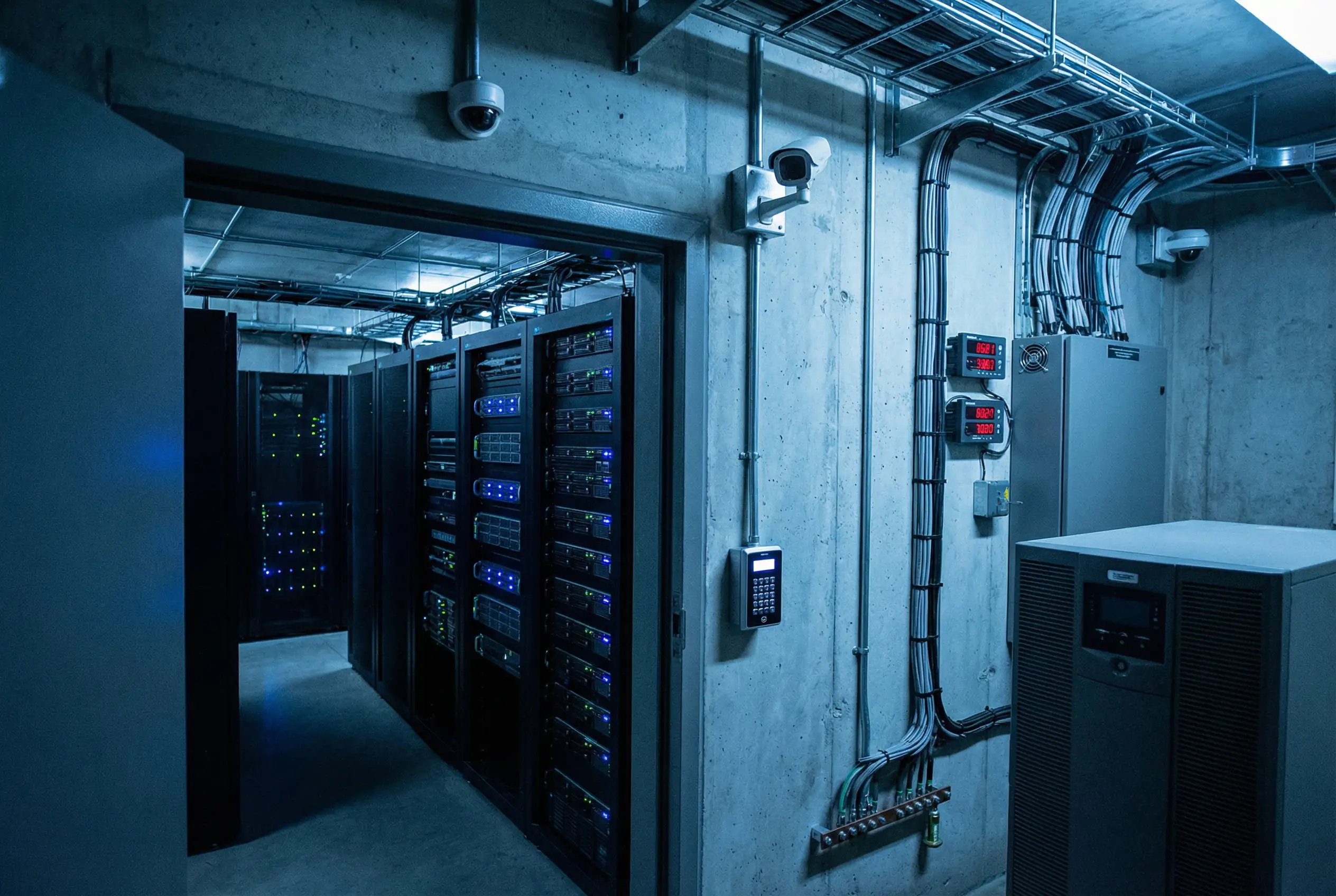
Underground server rooms and communication rooms house mission-critical IT infrastructure in a controlled environment with strict access requirements. Security objectives include two-factor access control with anti-tailgating, full video coverage of server aisles and rack fronts, environmental monitoring (temperature, humidity, smoke), and integration with the building management system (BMS). The environment is typically clean and climate-controlled, but the high value of assets demands the highest access control rigor. Cameras must not interfere with equipment cooling airflow. All cabling must be neatly managed to avoid obstruction during equipment maintenance.
3.6 Underground Pump Room & Water Plant
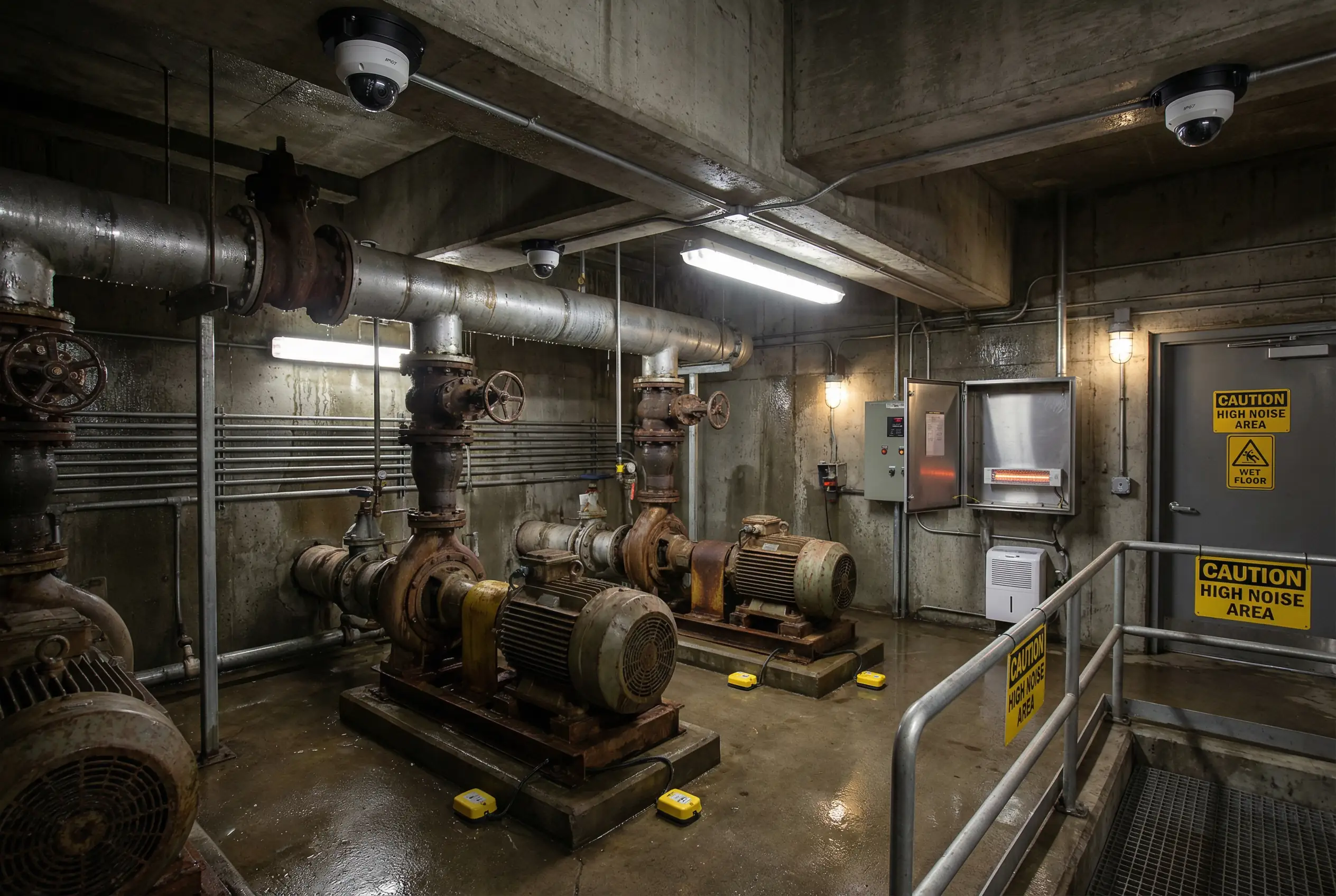
Underground pump rooms and water treatment plants present the most demanding environmental conditions: near-100% relative humidity, constant vibration from pump motors, water spray and splash, high noise levels (85–100 dB), and potential chemical exposure. Cameras must be IP67 minimum with anti-vibration mounts to prevent premature bearing failure. Audio analytics are impractical due to constant mechanical noise; video analytics must be tuned for high-contrast conditions. Water leak sensors are mandatory at all pump bases. Cabinet heaters and dehumidifiers must be active continuously. Maintenance access is typically limited to scheduled shutdowns.
3.7 Underground Warehouse & Storage Corridor
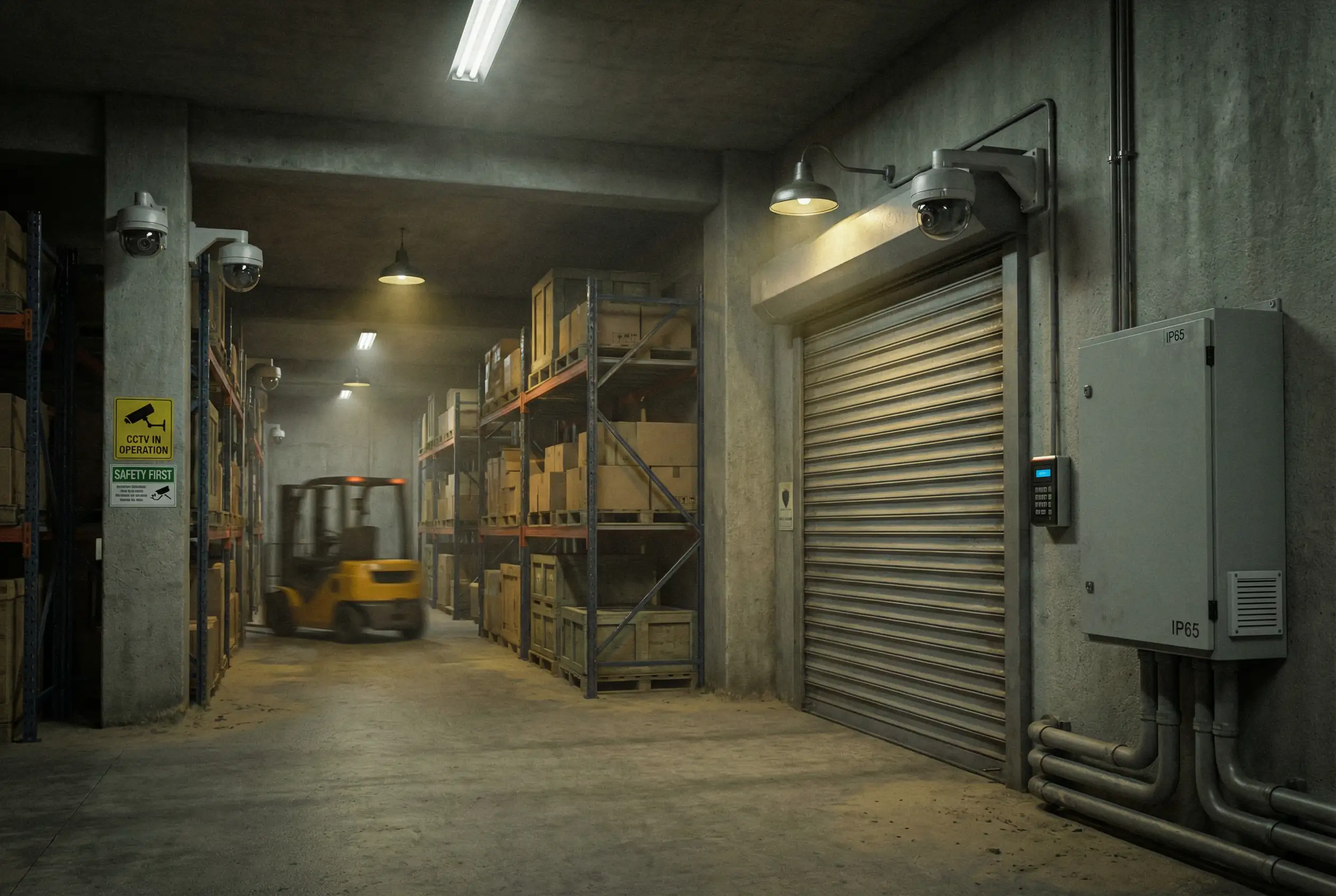
Underground warehouses and storage corridors combine dust from goods handling, forklift traffic that creates motion blur challenges, high storage racks that create blind zones, and access control requirements at loading docks and inventory rooms. Cameras at aisle ends require varifocal lenses for flexible coverage adjustment as rack configurations change. IP65 cabinets with dust filters are essential. Forklift-mounted IR illuminators can create temporary overexposure — cameras must handle rapid illuminance changes. Access control at roller doors and inventory rooms must support vehicle-triggered modes (loop detector or radar) in addition to personnel credential modes.
3.8 Enclosed Factory Storage Zone

Enclosed factory storage zones combine industrial OT network environments with security surveillance requirements, creating unique integration challenges. Separate cable trays for OT and security networks are mandatory to prevent interference and comply with industrial cybersecurity standards. Access control on hazardous materials storage rooms must integrate with the plant safety system (PSS) for emergency lockdown. Cameras must handle industrial lighting variability including high-intensity task lighting and dark storage areas. The OT/IT gateway provides controlled integration between the security platform and the plant SCADA system for automated alarm correlation.
3.9 Scenario Selection Summary
The following table consolidates the key selection parameters across all eight scenarios, providing a quick-reference guide for matching site conditions to the appropriate solution package. When a site exhibits characteristics from multiple scenarios, the most demanding requirements from each applicable scenario should be combined into a composite specification.
| Scenario | Key Environmental Challenge | Camera Class | Critical Sensor | ACS Requirement | Solution Package |
|---|---|---|---|---|---|
| 3.1 Parking Garage | IR bloom, wet floor, headlights | IP66/IK10 Dome + LPR | — | OSDP v2, fail-secure | B — Hardened |
| 3.2 Metro Station | Extreme WDR, crowd density | WDR Dome + Face-level | — | 2FA, anti-passback | C — High Availability |
| 3.3 Tunnel/Passage | Ultra-low lux, echo, long span | Corridor Mode, IR ≥30 m | Radar/LiDAR | Standard | B — Hardened |
| 3.4 Utility Tunnel | High RH, flood risk, corrosion | IP67/IP68 | Water Leak | OSDP v2, audit log | B — Hardened |
| 3.5 Server Room | High-value assets, cyber risk | IP Dome, clean environment | Env. Monitor | 2FA, anti-tailgating | C — High Availability |
| 3.6 Pump Room | Vibration, near-100% RH, noise | IP67 + anti-vibration | Water Leak | Standard | B — Hardened |
| 3.7 Warehouse | Dust, forklift motion blur | IP65 Varifocal | — | Loop + card | A — Standard |
| 3.8 Factory Zone | OT integration, hazmat, EMC | IP66 WDR Varifocal | OT/IT Gateway | PSS integration | C — High Availability |
Composite Site Rule: For sites combining multiple scenario types (e.g., a metro station with an adjacent pump room and server room), apply the most stringent requirement from each applicable scenario to the shared infrastructure (network, UPS, VMS) while applying scenario-specific requirements to the local field devices in each zone.